SUSPAVDES MODEL
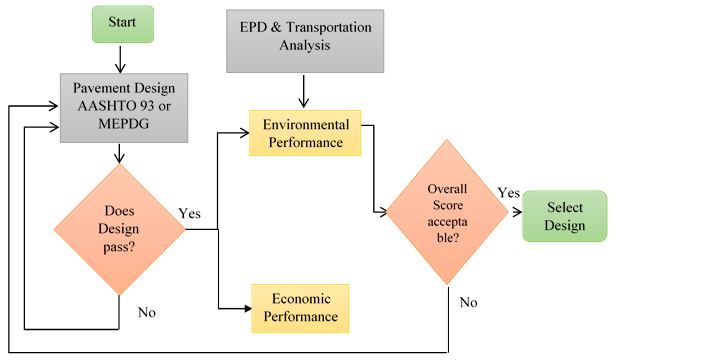
The software takes user input for pavement design, performance criteria weights, environmental impact categories weights, vehicular and fuel characteristics, distance from plant location to the job site and provides the cradle-to-gate environmental and economic performance.
The software evaluates economic and environmental performance for rigid pavement and only economic performance for flexible pavement based on user selection of pavement mixes from a library of 2382 existing pavement products.
WORKFLOW
Analysis Framework
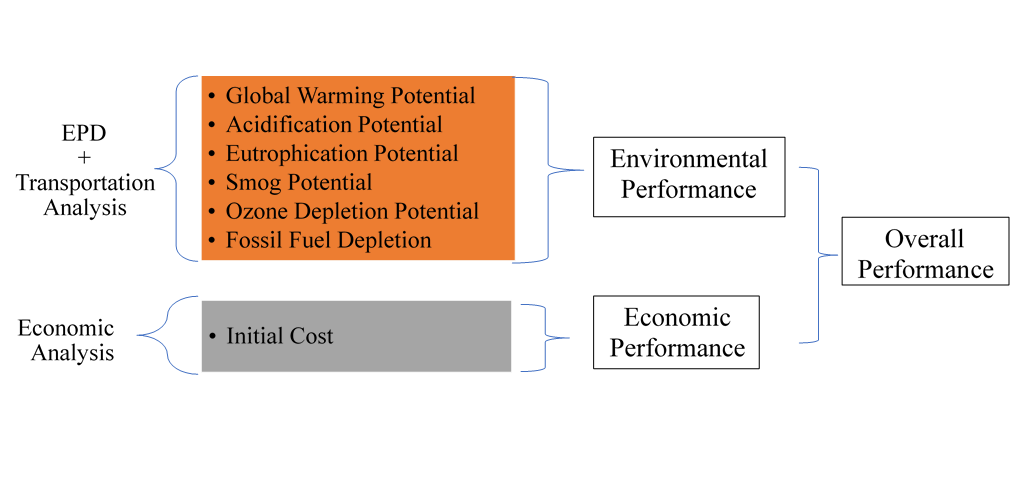
For EPD analysis, the impacts data corresponding to the pavement design/mix is extracted from the EPD database and converted into the functional unit (yd3/lane-mile) to compute the total impact value for each impact categories. The computed values are normalized in terms of U.S. flows per capita per year. For transportation analysis, based on the defined vehicular and fuel characteristics, the corresponding inventory data, collected from U.S. LCI database is used to quantify the total emission. The computed emissions are converted into the respective impact categories by characterization model and normalized as in EPD. The normalized values from both analyses were added and harmonized by a set of weights. The overall environmental score was then obtained by adding all the weighted impacts scores. Corresponding cost data for the selected mix is extracted from cost database and converted into the present value to represent economic performance. The environmental and economic performance score is converted into relative scale. Relative scales are synthesized by a set of weights which were then added to represent the overall performance score.
Note: The developed framework evaluates economic and environmental performance for rigid pavement and only economic performance for flexible pavement.

Exploring Decentralized Trading Platforms in the Modern Web3 Market
Web3 technology continues to expand the range of services available to digital asset users. Decentralized applications can provide direct access to trading, swapping, liquidity, and market information.
Understanding Decentralized Trading Services
The available functionality can vary considerably between blockchain applications. A beginner may prefer a straightforward interface, whereas an experienced trader may require more detailed market functionality.
A platform that can be included in an independent DeFi comparison is Archer Exchange. Independent research can help users understand whether its functionality matches their intended activity.
Selecting Tools for Individual Requirements
An additional platform for independent research is the Byreal Swap service. Before approving a swap, it is useful to review the selected assets, network, expected output, and wallet confirmation details.
Another project that may appear in decentralized exchange research is the Deriverse DEX platform. It should be approached as one of several possible research options rather than as a guaranteed solution.
Responsible Use of Blockchain Applications
Every decentralized application involves technical and financial risks. Careful users review transaction amounts, destination addresses, wallet permissions, and applicable fees before approval.
The DeFi market offers many possibilities, although no platform eliminates risk. Every user is responsible for evaluating the risks associated with blockchain transactions.